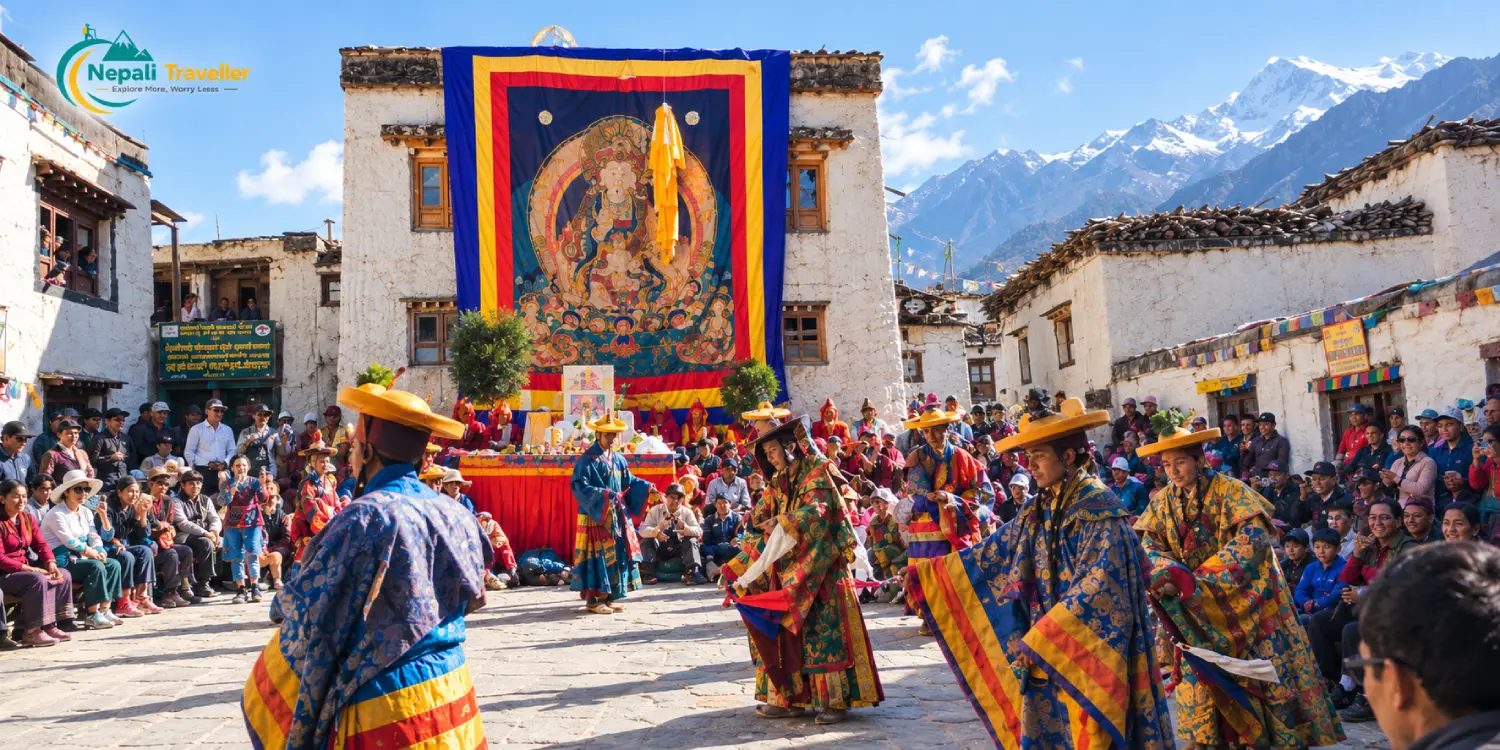

The Tiji Festival in Upper Mustang is one of Nepal’s most distinctive Himalayan cultural celebrations. Held annually in the ancient walled settlement of Lo Manthang, the three-day Buddhist festival brings together sacred masked dances, music, prayers, rituals, and centuries-old traditions rooted in Tibetan Buddhism.
For travelers planning an Upper Mustang Tiji Festival Tour in 2027, the main festival is scheduled for 1–3 June 2027 in Lo Manthang. The dates follow the Tibetan lunar calendar and should be reconfirmed closer to the festival because traditional lunar dates can differ from the Gregorian calendar used for travel planning. Multiple current 2027 festival schedules list 1–3 June as the dates for the three-day celebration.
Upper Mustang is a remote trans-Himalayan region of northern Nepal, famous for its dry landscapes, Tibetan-influenced culture, ancient monasteries, caves, and traditional villages. Lo Manthang, at around 3,840 metres, is the cultural center of the region and the principal setting for Tiji. Upper Mustang is a rain-shadow region with strong Tibetan cultural influences and note that a special trekking permit is required to enter the area.
Tiji Festival 2027: Dates at a Glance
| Information | Details |
|---|---|
| Festival | Tiji Festival / Tenchi |
| Year | 2027 |
| Dates | 1–3 June 2027 |
| Location | Lo Manthang, Upper Mustang, Nepal |
| Duration | Three main festival days |
| Altitude of Lo Manthang | Approximately 3,840 m |
| Cultural tradition | Tibetan Buddhism / Vajrayana |
| Main ritual performers | Buddhist monks of Chhode/Chode Monastery |
| Entry requirement | Upper Mustang Restricted Area Permit |
| Recommended arrival | At least 1–2 days before the first festival day |
Tiji is held annually according to the Tibetan calendar, traditionally during the third lunar month. The festival is associated with Vajrakila, also known as Dorje Phurba or Vajrakumar, a powerful Vajrayana Buddhist practice connected with overcoming negative forces.
What Is the Tiji Festival?
Tiji, also written as Tenchi or Teeji, is a three-day Buddhist ritual celebrated in Lo Manthang. The festival combines sacred masked dances, prayers, music, symbolic movements, and ritual offerings. The performances represent the triumph of positive forces over destructive or negative energies and are intended to promote peace, protection, prosperity, and harmony.
The tradition is associated with the Vajrakila meditation practice. Tiji’s history in Mustang reaches back centuries, with the tradition introduced and later revived through Buddhist masters and Mustang’s royal lineage. The festival is therefore more than a cultural performance. For the local community and participating monks, it remains a religious ritual.
The Mythology Behind Tiji
The story traditionally associated with Tiji centers on the struggle between Dorje Jono and destructive forces threatening the land. In popular accounts of the festival, Dorje Jono is portrayed as a protector who defeats a destructive demon and restores peace and prosperity to Mustang. The masked dances and ritual movements performed during Tiji represent different parts of this spiritual struggle.
The festival is more specifically connected with Vajrakila, a Vajrayana deity and meditation practice associated with removing negative forces. The ritual is believed to help eliminate obstacles and restore peace and harmony. This is why the dramatic costumes, masks, music, and choreography should not be viewed simply as entertainment. They are elements of a living religious tradition.
Cultural Significance and Ritual Practices
The Tiji Festival is closely associated with the Buddhist religious heritage of Lo Manthang and the surrounding Upper Mustang communities. The main rituals are traditionally performed by monks associated with Chhode (Chode) Monastery. Preparations for the ceremony involve extensive religious practice, and the dances incorporate symbolic gestures, costumes, masks, musical instruments, and ritual objects.
The three days progressively develop the central story and ritual.
Day 1: Opening Rituals
The first day introduces the main religious themes and begins the sequence of sacred dances. Monks appear in elaborate costumes and masks while performing choreographed movements accompanied by traditional instruments.
Day 2: Continuation of the Ritual
The second day develops the ritual narrative through additional masked dances, prayers, and symbolic movements. The courtyard becomes the center of religious and community activity.
Day 3: The Ritual Climax
The third day brings the festival to its conclusion. Ritual objects and effigies associated with negative forces are symbolically removed or destroyed, representing the banishment of obstacles and harmful energies.
On the final day, religious cakes are thrown away as part of the ritual of banishing negativity.
Where Is Tiji Festival Celebrated?
The Tiji Festival takes place in Lo Manthang, the historic walled settlement and former capital of the Kingdom of Mustang.
Lo Manthang lies in northern Mustang at approximately 3,840 metres above sea level. The settlement is surrounded by dramatic cliffs and high-altitude desert landscapes and is known for its monasteries, traditional mud-brick architecture, narrow lanes, and Tibetan-influenced culture.
Upper Mustang: The “Last Forbidden Kingdom”
Upper Mustang is popularly known as the “Last Forbidden Kingdom” because of its long period of isolation and its former status as the Kingdom of Mustang. However, the commonly repeated claim that the region opened to foreigners in 1992 should be corrected. Nepal Tourism Board states that Upper Mustang was opened to non-Nepali trekkers in 1994.
The region’s relative isolation helped preserve many traditional forms of architecture, religious practice, language, art, and community life. Today, visitors can explore ancient monasteries, caves, chortens, mani walls, traditional villages, and the distinctive desert-like landscape of the Kali Gandaki valley.
Upper Mustang Tiji Festival Tour 2027 Route
A Tiji Festival journey normally begins in Pokhara and proceeds toward Jomsom, the main gateway to Mustang. From Jomsom, travelers enter the Upper Mustang region through Kagbeni, where the restricted Upper Mustang area begins. The route then continues north through a series of traditional villages before reaching Lo Manthang.
A typical trekking route can include:
Pokhara → Jomsom → Kagbeni → Chele → Syangboche → Ghami → Tsarang → Lo Manthang
Depending on the itinerary and transportation conditions, some journeys use a combination of trekking and road transport.
1. Pokhara to Jomsom
Jomsom is the main gateway to the Mustang region. It can be reached by air from Pokhara when flights operate, or by road. Flights in the Kali Gandaki valley are highly dependent on weather and wind conditions, so travelers attending a fixed-date festival should allow contingency time.
2. Jomsom to Kagbeni
Kagbeni sits at approximately 2,800 metres and is an important historic settlement at the junction of the Kali Gandaki and Kag Khola valleys.It is also the traditional gateway toward Upper Mustang. Kagbeni is an important cultural and religious settlement with Buddhist shrines, chortens, and carved mani stones.
3. Kagbeni to Chele
Beyond Kagbeni, the landscape becomes increasingly dry and Tibetan in character. The trail passes through high-altitude terrain, cliffs, barren slopes, and traditional settlements.
4. Chele to Ghami
This section crosses several high passes and offers expansive views across the Upper Mustang plateau. Ghami is one of the region’s important traditional villages and is known for its Buddhist heritage and distinctive architecture.
5. Ghami to Tsarang
The trail continues through dramatic eroded landscapes and traditional settlements before reaching Tsarang, another historically important village in Upper Mustang.
6. Tsarang to Lo Manthang
The final approach leads toward the historic walled city of Lo Manthang. Lo Manthang can be reached in approximately four days from the lower Mustang approach, although the exact duration depends on the itinerary and mode of travel.
For a Tiji Festival itinerary, reaching Lo Manthang at least one or two days before 1 June 2027 is sensible. This allows time for altitude adjustment and provides a buffer against transportation delays.
How Long Does the Upper Mustang Tiji Festival Tour Take?
A complete Upper Mustang journey around Tiji generally requires more time than simply attending the three-day festival. A trekking-based itinerary can take approximately 12–16 days, depending on the starting point, acclimatization days, route, transportation, and return schedule.
A shorter itinerary using road transportation can reduce the number of trekking days, although road conditions and travel times can vary. The most important consideration is to avoid scheduling arrival in Lo Manthang on the morning of 1 June. Reaching the festival location early provides a much safer margin for weather, transportation, altitude, and road-related delays.
Permits and Regulations for Upper Mustang
Upper Mustang remains a restricted area, so foreign travelers need a special Restricted Area trekking permit.
The current Department of Immigration information lists the Upper Mustang permit at:
- USD 500 per person for the first 10 days
- USD 50 per person for each additional day
These are the current published rates and should still be checked before travel because government fees and regulations can change.
Is a Guide Required in Upper Mustang?
Yes. Upper Mustang is among the trekking regions where Nepal’s current rules require trekkers to be accompanied by a licensed trekking guide and to obtain the applicable trekking-agency-issued TIMS card. The Nepal Tourism Board’s current TIMS guidance specifically lists Upper Mustang Trek under the routes requiring a licensed trekking guide and TIMS card.
The restricted-area permit itself is processed through the appropriate government system and trekking-agency documentation.
What About the Annapurna Conservation Area Permit?
The route through lower Mustang also involves the Annapurna Conservation Area. The Nepal Tourism Board’s current protected-area fee information lists the Annapurna Conservation Area entry fee for foreign visitors at NPR 3,000 per person. Because permit systems and fees can be revised, travelers should confirm the current rates before departure.
Accommodation During Tiji Festival
Accommodation in Upper Mustang is generally made up of small hotels, guesthouses, teahouses, and family-run lodges. Facilities become more limited as you travel farther north. Lo Manthang has a larger selection of guesthouses than many smaller villages, but accommodation capacity remains limited compared with major trekking destinations.
During Tiji Festival, demand increases because local residents, domestic visitors, international travelers, guides, drivers, and trekking groups may all be in Lo Manthang at the same time. For this reason, accommodation should be arranged well before the festival. Travelers should not expect luxury facilities throughout Upper Mustang. Rooms can be basic, bathrooms may be shared, and heating can be limited.
Conclusion
The Upper Mustang Tiji Festival 2027 offers an opportunity to experience one of the Himalayan region’s most distinctive living Buddhist traditions in its original cultural setting. From the ancient villages along the Kali Gandaki corridor to the walled city of Lo Manthang, the journey combines dramatic trans-Himalayan landscapes with centuries-old Tibetan Buddhist heritage.
The three festival days, scheduled for 1–3 June 2027, are the centerpiece of the journey, but the wider Upper Mustang experience is equally important. Ancient monasteries, traditional villages, high mountain passes, caves, desert-like landscapes, and the unique culture of the Mustang people make the journey far more than a festival visit.
Because Tiji follows the Tibetan lunar calendar and Upper Mustang remains a regulated restricted area, travelers should verify the final festival schedule, permit requirements, fees, and transportation arrangements before traveling in 2027.
Frequently Asked Questions About Tiji Festival 2027
1. When is the Tiji Festival in 2027?
The Tiji Festival 2027 is scheduled for 1–3 June 2027 in Lo Manthang, Upper Mustang. Current 2027 travel and festival sources consistently list these three dates, although travelers should reconfirm the final festival schedule closer to the event because Tiji follows the Tibetan lunar calendar.
2. Where is Tiji Festival held?
Tiji Festival is held in Lo Manthang, the historic walled settlement in Upper Mustang, Nepal, at approximately 3,840 metres above sea level.
3. How many days does Tiji Festival last?
The main Tiji celebration lasts three days. The festival follows the Tibetan lunar calendar and traditionally occurs during the third lunar month.
4. What does Tiji mean?
Tiji, also known as Tenchi, is associated with a Tibetan Buddhist tradition connected with Vajrakila (Dorje Phurba). Nepal Tourism Board describes the festival as a sacred celebration involving rituals intended to remove negative forces and promote peace, prosperity, and harmony.
5. What is the story behind Tiji Festival?
The festival portrays the triumph of positive or protective forces over destructive forces. The story is traditionally associated with Dorje Jono, while the ritual tradition is connected with Vajrakila practice.
6. Do foreigners need a permit for Upper Mustang?
Yes. Upper Mustang is a restricted area, and foreign trekkers need a special trekking permit. The current Department of Immigration rate is USD 500 for the first 10 days and USD 50 for each additional day.
7. Is a guide mandatory for Upper Mustang?
Yes. Current Nepal Tourism Board TIMS rules list Upper Mustang among the trekking regions where trekkers must be accompanied by a licensed trekking guide and carry the appropriate TIMS card issued through a registered trekking agency.