Nepal Flood Update: Barrier Lake Bursts on Nepal-Tibet Border, Rescue Operations Suspended
 admin
8 min read
54 views
admin
8 min read
54 views Breaking: The Feared Second Flood Has Begun
Rescue operations along the Nepal-Tibet border have been suspended after officials confirmed on Friday, August 28, that the barrier lake threatening a second catastrophic flood has broken its banks. Nepal Police said they received information that the dammed lake on the Chinese side of the border had burst, and urged all rescuers, relief workers, security personnel, and residents in the area to move to safe ground immediately.
Narendra Pariyar, the chief district officer of Rasuwa, said his office received a notice confirming the lake had breached and that river levels were visibly rising, though it remained unclear how high the water would reach. Nepal’s Army sent a team to inspect the Bhote Koshi River amid fears of renewed flooding, and helicopter rescue missions in Rasuwa were grounded. Chinese state broadcaster CCTV reported that rescue teams near Gyirong Port, the border crossing devastated in Wednesday’s initial flood, had been ordered to pull back roughly one kilometre and await further instructions. Locals in the area were reported rushing to higher ground as word of the breach spread.
This is a developing situation. As of this writing, the scale of any new flooding downstream had not yet been confirmed, and both Nepali and Chinese authorities were monitoring the Bhote Koshi and Trishuli river systems closely.
How We Got Here: A Recap
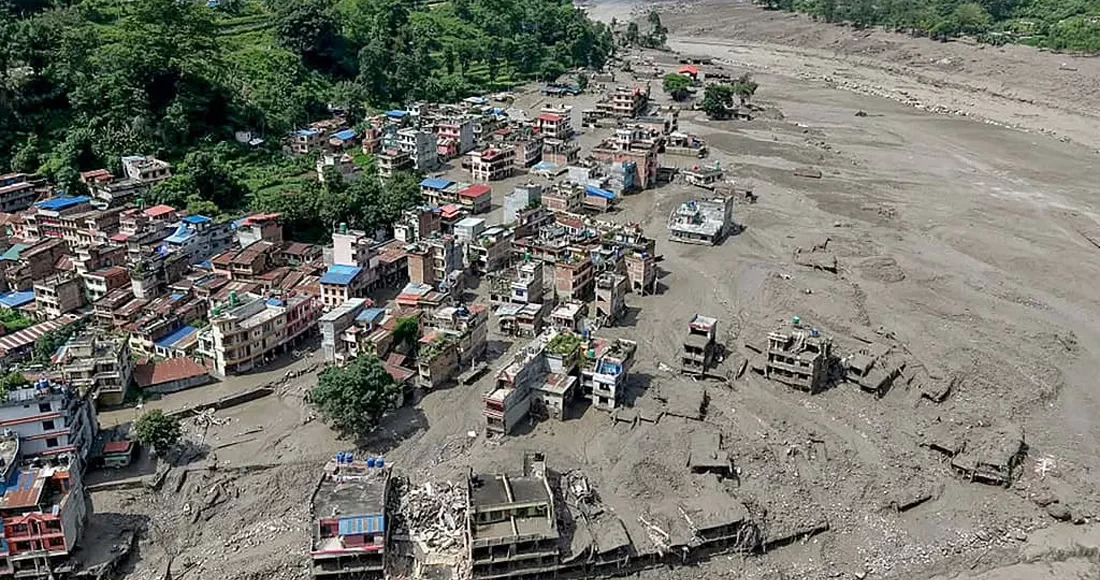
On the morning of August 26, 2026, a wall of mud, ice, and debris tore down the Bhote Koshi River valley in Rasuwa district, obliterating the border towns of Timure and Syabrubesi within minutes. Nepali and Chinese scientists have since concluded the disaster began when an ice-rock avalanche struck the Lhende River, a tributary of the Bhote Koshi, roughly 20 kilometres northeast of the Rasuwagadhi border crossing. The avalanche temporarily dammed the river; when that natural dam gave way, it released a debris-laden surge that tore downstream through Rasuwa and into the Trishuli river system, reaching as far as Chitwan district. Planetary Science Institute scientist Jeffrey Kargel told CNN the flood wave descended the first 22 kilometres at an average speed of around 193 km/h (120 mph), covering nearly 14 miles in under seven minutes, leaving almost no time for anyone in its path to react.
A magnitude-4.4 tremor recorded near the border shortly before the flood struck initially raised fears an earthquake had triggered it. That theory has since been set aside: monitoring by the GFZ Helmholtz Centre for Geosciences found the tremor was not consistent with a typical tectonic earthquake, and the US Geological Survey similarly found no standard earthquake occurred, reinforcing the view that the tremor itself was most likely a byproduct of the massive ice and rock collapse rather than its cause.
It was in the aftermath of this initial disaster that Chinese authorities identified a new, rapidly filling barrier lake forming near the confluence of the Chhochen Khola and Purepu Tsangpo rivers, warning by Thursday that it was already overflowing and at high risk of breaching within three days. That breach is what triggered Friday’s rescue suspension.
The Human Toll So Far
Nepal Police confirmed 469 deaths as of Friday morning, up from 390 a day earlier, according to CBS News, with the toll widely expected to rise further as search teams recover more bodies from the debris. Nepal’s police spokesperson, Abi Narayan Kafle, told Reuters the count “will go up, as we have resumed the search and more bodies are expected to be recovered.” China has confirmed 3 deaths and 2 rescued in Gyirong County on the Tibetan side, a figure that had not been updated as of Friday’s reports.
Combined, Nepal and China have said more than 1,500 people remain missing. In Nepal, more than 500 foreign nationals from 32 countries are unaccounted for, including at least 90 Americans, according to the US State Department, and the Nepal Tourism Board separately reported 127 missing domestic travellers. On the Chinese side, officials in Gyirong county reported 558 people missing, including 260 foreign nationals, though it remains unclear whether Nepal and China are counting some of the same individuals among the missing, according to NBC News. CNN reported that more than 1,300 people were believed missing in Nepal alone, including at least 700 foreigners.
At least 466 people have been injured, with many being treated at Kathmandu-area hospitals including Tribhuvan University Teaching Hospital, the National Trauma Centre, and Norvic Hospital, as well as facilities in Rasuwa and Trishuli closer to the disaster zone. UNICEF has said at least 14 children are among the confirmed dead.
Rescue and Evacuation Effort
Despite Friday’s suspension, rescue efforts through the week have been extensive. Nepal’s National Disaster Risk Reduction and Management Authority said Friday that 3,253 people had been airlifted by helicopter out of the disaster zone since Wednesday. CNN reported that 555 stranded tourists had been relocated and 499 affected villagers evacuated by Thursday. China said it had deployed more than 500 personnel to search-and-rescue operations along its side of the border.
Teams from the United Nations and the International Red Cross, who had been visiting flood-affected areas including Nuwakot, changed course following Friday’s reports of the barrier lake breaking its banks; some UN personnel returned to Kathmandu, though humanitarian workers remain on the ground, according to the UN’s national information officer in Nepal, Simrika Sharma. David Fisher, head of the Red Cross delegation in Nepal, said the organization was “very concerned” and that Red Cross teams were moving to safety while helping to disseminate the alert to residents.
Helicopter footage released by the Tibet Military District of China’s People’s Liberation Army showed the scale of destruction at the Gyirong checkpoint, which, compared with earlier satellite imagery, has been left with nothing recognizable standing, the site covered in mud and debris.
Government and International Response
Nepal has formally requested assistance from both India and China with rescue efforts, according to government spokesperson Sasmit Pokharel. US President Donald Trump said the United States would send Nepal “any help that they need,” and the State Department said it was supporting affected Americans around the clock. Australia’s Foreign Minister Penny Wong has said at least 39 Australians are among the missing, while India’s Ministry of External Affairs has been tracking roughly 290 unaccounted-for Indian nationals.
Infrastructure and Economic Damage
The initial flood alone severed roughly 40 kilometres of road and destroyed 41 bridges in Rasuwa. Multiple hydroelectric projects were damaged or knocked offline, including the 111-megawatt Rasuwagadhi Hydropower Project, the Chilime Hydropower Project, the Trishuli-3A project, and the 20-megawatt Langtang Khola Hydropower Project. Nepal’s Electricity Authority estimated around 430 megawatts of production capacity was affected. The Rasuwagadhi-Gyirong crossing, a major trade and transit point between Nepal and Tibet, remains closed, and Nepal’s stock market has slid on hydropower and insurance shares in the days since the disaster. Nepal’s National Planning Commission has begun a formal assessment of the broader economic damage.
Why the Warning Failed
A recurring theme in Nepali media coverage this week has been the near-total absence of advance warning ahead of Wednesday’s initial flood. Officials at the Rasuwa District Administration Office told the Kathmandu Post they had no information about the flood before it struck, despite it originating well upstream in Tibet. Anil Pokhrel, former executive chief of Nepal’s National Disaster Risk Reduction and Management Authority, said similar cross-border monitoring failures had occurred in past floods but had not been taken seriously enough; even monitoring equipment installed on Nepal’s own territory reportedly failed to issue an alert. That gap is now under renewed scrutiny as Friday’s second warning, at least, appears to have reached authorities and triggered a rescue pause before floodwaters arrived, a marked contrast to Wednesday’s no-warning disaster.
A Recurring Threat in the Himalayas
Rasuwa’s location, straddling steep mountain terrain along a glacier-fed river system, makes it especially vulnerable to sudden flash floods and landslides, a vulnerability scientists say is intensifying with climate change. This is the second major flood to strike the same stretch of the Bhote Koshi River within roughly 13 months, following a smaller, related flood in July 2025 that killed at least nine people. Maps published by the International Centre for Integrated Mountain Development (ICIMOD) and the UN Development Programme have identified more than 3,600 glacial lakes across the region’s major river basins, of which 47 are considered at particular risk of bursting, roughly half of them located across the border in Tibet.
This article reflects the latest confirmed information available as of the afternoon of August 28, 2026, following reports that the barrier lake on the Nepal-Tibet border has breached. This is a fast-moving situation; casualty figures, missing-persons counts, and the scale of any renewed flooding are likely to change in the hours ahead.